
You find identifying gulls challenging. Many gulls, often called “sea gulls,” look very similar. This makes these birds one of the most difficult groups to identify. However, a structured approach focusing on key features makes accurate gull identification much more manageable. This guide provides a clear gull identification chart for 11 common species. You will learn their distinguishing characteristics. This enhances your birdwatching experiences. It also helps you contribute to citizen science, understanding more about these fascinating gulls. Identifying different seagull species deepens your appreciation for every unique gull. This journey into gull identification is rewarding.
Key Takeaways
Learning to identify different gulls helps you understand nature better. It also helps scientists study birds.
Look at a gull’s size, feather patterns, bill color, and leg color. These features help you tell different gulls apart.
Gulls change how they look as they get older and during different seasons. Always consider a gull’s age and the time of year.
Use binoculars to see details. Practice often and be patient. This will make you better at identifying gulls.
Why Gull Identification Matters
Beyond Just “Sea Gulls”
You might call all these coastal birds “sea gulls.” However, this common name hides a world of diversity. Many different species of gulls exist. Each gull has unique behaviors and roles. Learning to tell them apart opens your eyes to this variety. It moves you past a general term to specific, fascinating birds. Accurate gull identification helps you understand each individual gull better.
Ecological Insights and Citizen Science
Understanding specific gulls helps scientists study ecosystems. For example, Herring Gulls and Great Black-backed Gulls forage differently. They compete for food, especially when raising young. Gulls often divide resources, like food or nesting spots, to live together. This division helps them coexist. Knowing which gull is which provides crucial data.
Your accurate identification also helps citizen science projects. These projects rely on observations from many people. For instance, researchers used accurate records of Lesser Black-backed Gulls to study their habitats. This data helps scientists understand how environmental changes affect birds. Projects like those at Cornell University use your observations. They track bird migration, nesting success, and population changes. These insights are vital for protecting gulls and their homes. Your careful observation of gulls contributes to real conservation efforts.
Enriching Your Birdwatching
Knowing different gulls makes birdwatching more rewarding. You move from seeing just “a gull” to identifying a specific species. This adds depth to your observations. You notice subtle differences in size, color, and behavior. Each identified gull becomes a small victory. This deeper understanding enhances your connection to these common birds. It transforms a simple sighting into a meaningful learning experience.
Key Gull Identification Features
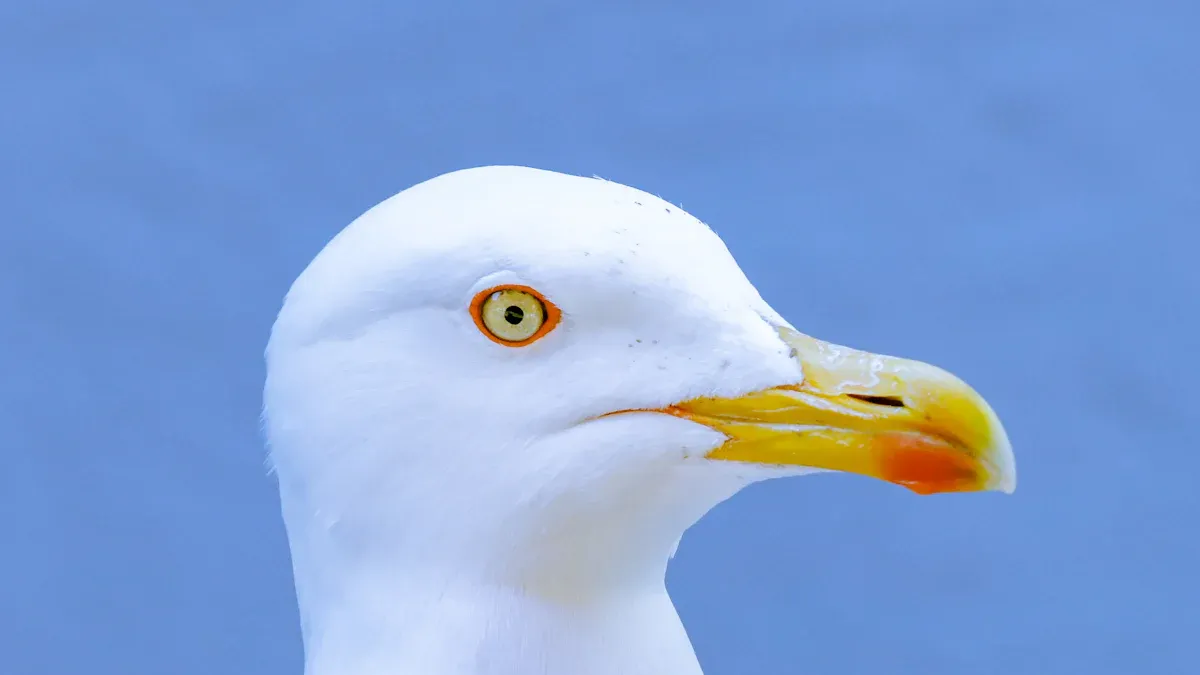
You identify gulls by observing several primary characteristics. These features help you distinguish one species from another.
Size and Shape
You first notice a gull’s size and shape. Gulls vary greatly. Some are small and delicate. Others are large and robust. You observe slender bodies or stocky builds. Overall body proportions provide important clues. For example, a Little Gull is small. It weighs about 120 grams (4.25 ounces). It measures 29 centimeters (11.5 inches). A Great Black-backed Gull is very large. It weighs 1.75 kg (3 lb 14 oz). It measures 76 cm (30 inches). This size difference is a key for gull identification.
Gull Type | Species | Weight | Length |
|---|---|---|---|
Small | Little Gull | 120 grams (4.25 ounces) | 29 centimeters (11.5 inches) |
Large | Great Black-backed Gull | 1.75 kg (3 lb 14 oz) | 76 cm (30 inches) |
Plumage Patterns
You observe plumage patterns. These patterns change with age and season. Adult gulls look different from juvenile gulls. You see seasonal variations. Breeding plumage differs from non-breeding plumage. Wingtip patterns are crucial. They show black with white spots or solid black.
Feature | Adult Gulls | Juvenile Gulls (to 3rd winter) |
|---|---|---|
Tail | All white | Black terminal band (fading in 3rd year) |
Overall Color | Grey/white (e.g., Common Gull) | All brown (e.g., Common Gull), more brown indicates younger |
Legs | Green/yellow (e.g., Common Gull) | Pink (e.g., Common Gull) |
Bill | Green (e.g., Common Gull) | Pink (e.g., Common Gull) |
Mantle | Grey (e.g., Common Gull 2nd winter onwards) | Brown (e.g., Common Gull 1st winter) |
Wing Markings | Mirror on primary feathers (e.g., BHG) | Brown markings on back and wings (e.g., BHG 1st year) |
Head | Less mottled (e.g., Common Gull 2nd winter) | Mottled brown (e.g., Common Gull 2nd winter) |
First-winter American Herring Gulls appear stocky and dark. They have blotchy plumage. Their faces are dark. Their bills are mostly blackish. Pale American Herring Gulls have smooth pale gray-brown plumage. They show streaked breasts. Their faces are very pale. They have neatly checkered wing coverts. These gulls look sleek and slender. Their bills are subtly two-toned. They often show a paler rump.
Bill Color and Shape
You examine the bill’s color and shape. These features are diagnostic for many gulls. European Herring Gulls show variations in bill characteristics. Their gape curvature ranges from almost straight to clearly curving downwards. This influences the gull’s general appearance. The bill tip often extends past the lower mandible. Its extension varies. The gonys spot is predominantly orange. It is occasionally reddish. Its brightness varies. Many adult gulls display black markings on the bill tip during the non-breeding season. These typically disappear by the breeding season. Some individuals retain them into the summer. Ring-billed Gulls have a fairly short and slim bill. Their bill coloration changes with age. Adults have a yellow bill with a distinct black band. First-winter birds possess a short bill. It is pink at the base. Juveniles have a dark bill. It is most often pink at the base.
Leg Color
You note the leg color. This is a simple yet effective identification feature for gulls.
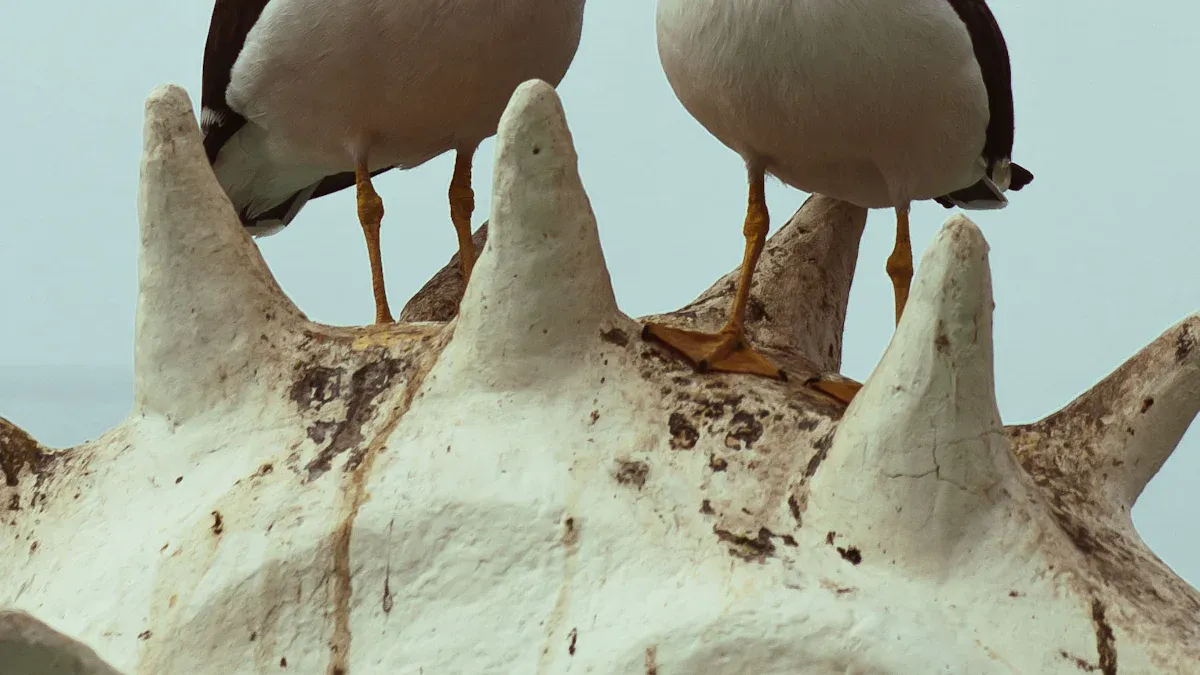
Breeding and Nonbreeding Adults: Yellow legs.
First-year Gulls: Pinkish legs.
Second-year Gulls: Bluish legs. Some second winter birds show a bluish tint on the upper legs.
Habitat and Range
You consider the gull’s habitat and range. Location helps narrow down possibilities. The American Herring Gull is highly adaptable. It is a widespread species. It nests in diverse habitats. These include Arctic tundra, boreal forest lakes, and city rooftops. They forage in intertidal zones for shellfish. They also find fish in lakes and oceans. They eat earthworms in farm fields.
They consume berries in barrens. They gather near fishing boats for discarded waste. They visit industrial farms and human refuse sites. American Herring Gulls are common in the North Atlantic. You find them across much of coastal North America during winter. They breed in Canada and the United States. Their nonbreeding range extends as far south as Central America.
You observe them along coastal shorelines, beaches, and refuse dumps. Any large open space near water serves as a winter gathering spot. This is especially true along the North Atlantic Coast, the Great Lakes, and the southern Alaskan coast. Short-billed Gulls breed in Alaska and northern Canada. You commonly find them along the Pacific coast of Canada and the U.S. during their nonbreeding season. They inhabit Pacific beaches, adjacent estuaries, and grassy fields.
Gull Identification Chart: 11 Common Species
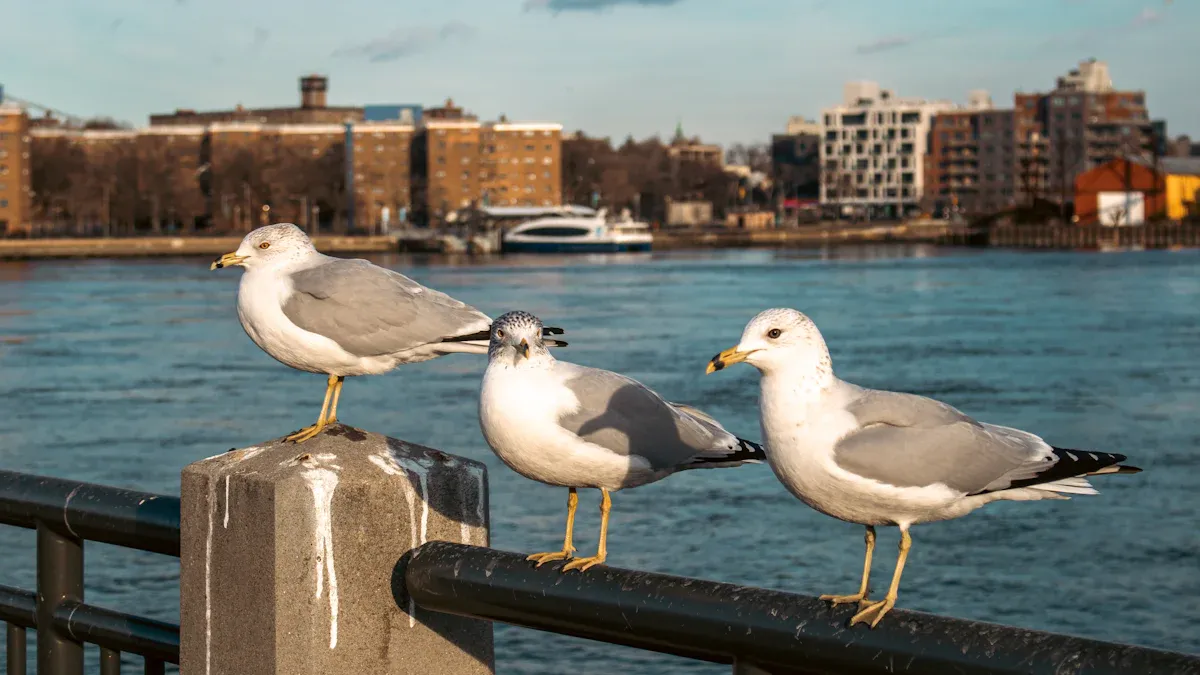
You can master gull identification with this detailed gull identification chart. It highlights key features for 11 common species. This guide helps you distinguish between many different gulls.
Herring Gull
You recognize the Herring Gull (Larus argentatus) as a large gull. It has a white head and a light gray back. Its wingtips are black with white spots. You will notice its pink legs. Its yellow bill features a distinct red spot on the lower mandible. This gull is common across North America and Europe. It often has a raucous call. You might confuse it with Ring-billed Gulls, but its larger size and bill features help you tell them apart.
Adult Herring Gulls have similar plumage for both sexes. Their heads and underparts are white. Their backs are light gray. The outermost wing feathers are black and have a white spot. During winter, adults show streaks of brown on their heads. They have golden eyes surrounded by a yellow-orange ring of skin. You will see a classic black band across both webs of the P5 feather, forming a distinct ‘W’ shape, especially in American Herring Gulls. A long tongue on P10 and a black mark on the outer web of P4 are also common. This large gull acquires adult plumage in its fourth year. Its pink legs are a helpful identifier.
Ring-billed Gull
You identify the Ring-billed Gull (Larus delawarensis) as a medium-sized gull. It measures 43 to 54 cm long. Its wingspan is 105 to 117 cm. This gull has a white head, neck, and underparts. Its back and wings are silver-grey. Black wingtips feature white ‘mirrors’. You will see yellow legs and yellow eyes with red rims. A key identifier for this gull is the black band encircling its yellow bill. This helps you differentiate it from other gulls. Immature birds are much paler and grayer than young Herring Gulls or California Gulls. They have a black-tipped pink bill. This gull attains adult plumage in its third winter.
California Gull
You can identify the California Gull (Larus californicus) as a medium-sized gull. It has a medium gray back and yellow legs. Its eyes are dark. Adult California Gulls have a white head. Nonbreeding adults show brown streaking on their heads. This gull lives in western North America.
Newly born California Gulls have thick, soft, light-colored down. First-winter juveniles have a brown mantle and wings. Their heads are brown, and their legs are pink-tinted. Around two years old, the tail turns white, and the bill becomes yellow. By the third year, the gull almost completely resembles an adult. However, the adult bill and wing patterns are not fully developed. In its fourth winter, it achieves an adult appearance. This includes a white head, dark grey mantle, yellow-green legs, a reddish eye ring, and black wingtips. The adult bill is yellow with a red gonys-spot and dark markings. It often appears four-colored. This is a unique pattern among West Coast gulls.
Laughing Gull
You will easily spot the Laughing Gull (Leucophaeus atricilla) by its distinctive black head in breeding plumage. It has a dark gray body and a long, red bill. Its wings are significantly darker grey than other similarly sized gulls. They lack the white crescent seen in Franklin’s gull. This gull prefers coastal habitats in the Americas.
In breeding season, Laughing Gulls have crisp black hoods. Their backs and wings are considerably darker than common medium-sized gulls like Ring-billed Gulls. They have white body parts. Sometimes, a fading pink breast appears upon arrival at breeding grounds. Their legs and feet are deep red. They lack a white band separating the black primaries from the rest of the grey wings. You will also notice a broken white eye ring.
Great Black-backed Gull
You recognize the Great Black-backed Gull (Larus marinus) by its very large size. It is distinctly larger than the Lesser Black-backed Gull. This great gull has a dark black back and wings. It has a white head and pink legs. Its yellow bill features a red spot. You will notice conspicuous, contrasting white ‘mirrors’ at the wing tips. No other very large gull with black on its upper-wings generally occurs in the North Atlantic.
Juvenile Great Black-backed Gulls, under a year old, have scaly, checkered black-brown upper parts. Their heads and underparts are streaked with grey-brown. Their legs are dark bluish-grey with some pink tones. Their bill is brownish-black with a white tip. This great gull takes at least four years to reach maturity.
Lesser Black-backed Gull
You identify the Lesser Black-backed Gull (Larus fuscus) as smaller than the Great Black-backed Gull. It has a dark gray or black back. Its legs are yellow. Its yellow bill features a red spot. This gull has an increasing presence in North America.
This medium to large gull is slimmer than a Herring Gull. It has rather long, pointed wings. These wings extend far beyond the tail when perched. It has a larger head and a thicker bill than medium gulls. Adult breeding plumage shows white below and slate gray above. It has a white head, black wingtips, and a yellow eye. Nonbreeding adults have a spotted brown head and neck. Juvenile plumage is brown above with pale feather edges. It has a blackish tail band. The Baltic Gull subspecies is truly blackish above. It is a three-year gull, reaching adult plumage in its third year.
Bonaparte’s Gull
You will find the Bonaparte’s Gull (Chroicocephalus philadelphia) to be a small gull. It measures 28-38 cm in length. In breeding plumage, it has a black head and white underparts. Its wings are pale grey with black wingtips. It has a slender black bill and red legs. During the non-breeding season, its head is white with a small dark spot behind the eye. This is the only other New Hampshire gull with a similar marking, besides the offshore Black-legged Kittiwake. You will notice extensive white in its outer wing feathers during flight. This is visible in all plumages. This bonaparte’s gull is known for its graceful flight.
Mew Gull / Common Gull
You identify the Mew Gull / Common Gull (Larus canus) as a medium-sized gull. It is 40–46 cm long. It has a clean white head and a medium gray back. Its legs are yellow-green. Its bill is slender and yellow. This gull has a more delicate appearance.
Its eyes are typically dark. Its bill structure shows an upper mandible that narrows evenly in a smooth curve. You will see larger white mirrors on P10 and P9 compared to the Ring-billed Gull. White is present between the black tips and gray bases of the outermost primaries. The mantle is darker than in the Ring-billed Gull. Young birds have pink legs, which become grayish in the second year before turning yellow. This gull takes three to four years to reach maturity.
Glaucous-winged Gull
You recognize the Glaucous-winged Gull (Larus glaucescens) as a large gull. It has a pale gray back and wings. It lacks black wingtips. Its legs are pink. Its yellow bill features a red spot. This gull lives along the Pacific coast.
Its mantle (back and wings) is solid gray-blue in non-breeding adults. Its tail is white. Its head is white, streaked with brown in non-breeding adults, and pure white during breeding season. The bill is very large. Its wingtips are gray or gray-black, not deep black. You will see a band of blue-gray on its underwings. A key identification characteristic is that no other large gray-mantled gull exhibits primaries (wingtips) that are uniformly dark with the upperparts. This gull displays a continuous and uniform medium gray mantle across its back and wings, extending to the wingtips. It has no black in the wingtips across any of its four-year plumages.
Western Gull
You identify the Western Gull (Larus occidentalis) as a large, heavy-bodied gull. It is larger than a Herring Gull but smaller than a Great Black-backed Gull. This gull has a dark gray back and a white head. Its legs are pink. Its yellow bill features a red spot. This gull lives along the Pacific coast of North America.
Feature | Description |
|---|---|
Size | Large, heavy-bodied |
Length | 22.1-26.0 inches (56-66 cm) |
Weight | 28.2-44.1 ounces (800-1250 g) |
Wingspan | 47.2-56.7 inches (120-144 cm) |
Head/Neck/Bill | Thick neck, large head, heavy bill with a thick tip |
Breeding Adult Coloration | White body, black (or dark gray) back and upperwings, black primary feathers |
Bill (Breeding Adult) | Yellow with a red mark near the tip |
Legs/Feet (Breeding Adult) | Pale pink |
Eyes (Southern Subspecies) | Olive-yellow |
Eyes (Northern Subspecies) | Dark brown |
The northern subspecies (occidentalis) has notably paler upperparts and darker eyes. The southern subspecies (wymani) has darker upperparts and olive-yellow eyes. This gull eats birds, eggs, nestlings, fish, invertebrates, carrion, and trash. It forages along sandy and rocky beaches.
Franklin’s Gull
You recognize Franklin’s Gull (Leucophaeus pipixcan) as a medium-small gull. In breeding plumage, it has a black head and a dark gray back. Its bill is red. You will notice white eye crescents. This gull breeds inland and has migratory habits.
Breeding adults feature a bold black hood. They have contrasting white crescents above and below the eye. Their bill is bright reddish. Their upperparts are medium gray, and underparts are white. In flight, you will see a distinctive white trailing edge to the wings. Non-breeding adults lack the full hood. They retain only a smudgy dark mask on the head. This gull often shows a rosy pink cast on the chest and abdomen during the breeding season. This earns them the nickname “rosy dove.” This pink coloration can be visible even in flight. This bonaparte’s gull has slightly smaller bills compared to other gull species like the Laughing Gull.
Gull Identification Tips
You can improve your identification skills with practical advice. You will learn to spot different gulls more easily.
Observe Multiple Features
You should look at many features. Do not rely on just one thing. This is crucial for accurate gull identification. You need to systematically look for specific features. These include leg color, mantle shade, wingtip color, orbital color, bill pattern, and eye color. You also account for plumage variations, bleaching, wear, molt, and light conditions. These factors all change how a gull looks.
Consider Age and Season
You must consider a gull’s age and the season. Gulls look very different at different ages. Young gulls go through many plumage changes. They take several years to reach adult plumage. Smaller gulls take three years. Larger gulls take four years. Their feathers continuously molt and fade. This means gulls are easier to identify in the fall. Their plumage is fresh then. In spring and summer, feathers are often faded. This makes identification harder. There can be many distinct plumages for gulls. This is due to age and seasonal molt.
Use Binoculars and Guides
You should use binoculars for detailed observation. Binoculars with 10x magnification offer a closer look. They help you see details. Look for binoculars that are fog and waterproof. Anti-reflective lens coatings improve image quality. A wide field of view helps you find and follow birds. If you wear glasses, look for binoculars with 11mm or more eye relief. You should also consult multiple field guides. This helps you cross-reference what you see.
Practice and Patience
Practice and patience are very important. You will master gull identification over time. Focus on a gull’s body structure and behavior. Do not just look at plumage. Use photo quizzes in identification guides. Start by identifying common local gulls. This simplifies your learning. Pay close attention to bill shape, size, and color. Look at eye color, wing length, and head size. Observe how gulls feed and fly. Consistent practice with your binoculars improves your skills. You will soon identify many different gulls.
You know gulls are hard to identify. Still, mastering their identification is very rewarding for birdwatching. These gulls offer much to learn about each specific gull. Successful gull identification uses a systematic approach. You pay attention to key features.
These include size, plumage, bill, legs, and habitat. This helps you identify each specific gull. Use this gull identification chart. It is a foundational tool for your birdwatching. You will appreciate these fascinating birds more deeply. These birds are truly amazing. Each gull has its own story. This chart helps you find every gull. Birding is a continuous learning journey. You will feel satisfied when you correctly identify a challenging gull. Keep observing these amazing birds. Many different gulls exist. You will learn about all these gulls. Identifying these birds is a great skill. Every gull is unique. You will love identifying each gull.