
Owls captivate with their mystery. These nocturnal birds are creatures of the night. Spotting an owl in the wild is a special thrill. Their camouflage makes finding them a unique challenge. This owl identification chart helps you discover where to spot them. It guides you on where to spot them by appearance. You will confidently identify each owl by its calls, habitat, and where to spot them based on behavior. This comprehensive owl identification chart covers 15 amazing owls. Learn where to spot them and their unique characteristics.
Key Takeaways
Identify owls by looking at their size, feather colors, and ear tufts. Also, listen to their unique calls.
Know where owls live. Different owls prefer different places like forests, grasslands, or deserts.
Watch how owls act. Some hunt at night, others during the day. Their behavior helps you know who they are.
Always keep a safe distance from owls. Do not disturb them or their nests. Use binoculars to see them up close.
Using Your Owl Identification Chart
Identifying an owl in the wild requires more than just a quick glance. It involves a multi-sensory approach. This owl identification chart helps observers combine visual cues with auditory information and environmental context.
Key Features for Identification
Visual characteristics are crucial for identifying an owl. An owl’s eyes are large and fixed in their sockets. They face forward, giving the owl excellent binocular vision. Since their eyes do not move, an owl compensates by rotating its head up to 270 degrees. This allows it to see in many directions without moving its body. Plumage also provides important clues.
An owl’s feather coloration helps it blend into its surroundings. For example, the snowy owl has white feathers for camouflage in snow. The tawny owl has speckled brown feathers for woodland habitats. Other key features include the owl’s overall size, the presence or absence of ear tufts, and the shape of its facial disc.
Listening to Distinctive Calls
Many owls are nocturnal. Hearing their calls often provides the first clue to their presence. Each owl species has unique vocalizations. Learning these sounds is essential for identification. Common owl call types include a typical call, an A-song, and a B-song. Some owls make a female contact call or various calls for different situations. An alarm call warns others of danger. Series calls or a mewing scream can also be distinctive. Some species perform a wail call or typical calls in pairs. A typical duet is also common for some owls.
Understanding Habitat
An owl’s habitat offers significant clues for identification. Different owl species prefer specific environments. Some owls live in dense forests, while others favor open grasslands or deserts. Knowing which owl species typically inhabit a particular area helps narrow down possibilities. For instance, a burrowing owl lives in open, treeless areas. A great horned owl adapts to many different habitats, from forests to urban parks.
Observing Behavior
An owl’s behavior also aids in identification. Observing how an owl hunts, perches, or interacts with its environment provides valuable information. Some owls are strictly nocturnal, hunting only at night. Others, like the short-eared owl, are crepuscular, active at dawn and dusk. Noticing an owl’s flight pattern or its preferred perching spots can help confirm its identity.
Spotting Wild Owls: General Tips
Observing wild owls requires patience and respect for nature. These general tips help you increase your chances of a sighting. They also ensure you practice responsible birdwatching.
Best Times for Owl Spotting
Knowing where to spot them often depends on the time of day. Owls are most vocal in January and February. They establish territories and seek mates during winter. While you can hear owls year-round, dawn and dusk are particularly active periods. Their activity overlaps with human observation times. This is a good time to know where to spot them. Many owls hunt during the night. Some owls break the nocturnal mold. Short-eared Owls, Burrowing Owls, and pygmy-owls are most active and vocal during the day. Barred Owls are also frequently heard during the day. This knowledge helps you understand where to spot them. The quiet of the night offers unique opportunities to hear and sometimes see these elusive birds.
Ethical Viewing Practices
Always maintain a safe distance from owls. If an owl shows signs of discomfort, you are too close. Signs include fidgeting, repeatedly staring, head-bobbing, or changing position. You should retreat immediately. If your presence causes an owl to flush, you were definitely too close. Adjust your approach for future observations. Be especially careful to keep your distance from owl nests. Human disturbance and scent can attract predators. Maintain your distance; if you observe any change in the bird’s behavior, you are too close. Limit the duration of your presence near the bird. Refrain from widely or publicly sharing the exact location of rare birds or nests.
This protects the birds from excessive disturbance. Utilize binoculars, a scope, or a telephoto lens for viewing owls. This helps you maintain a significant distance. Ensure your distance is sufficient so the owl remains unaware of your presence. If an owl exhibits signs of awareness, move further away. Stop any photography. When observing owls hunting in a field, stay on the periphery. Give them ample space. Avoid flushing the bird. Do not use flash photography or flashlights. Never bait owls with live or dead animals. These practices ensure you can enjoy where to spot them without harming them.
What to Look For
When searching for an owl, look for specific features. Owls have large heads and forward-facing eyes. These features make them distinct among birds. Their camouflage often blends them into trees. Scan tree branches carefully. Look for irregular shapes or textures that do not match the bark. Sometimes, you can spot an owl silhouette against the sky. Knowing where to spot them involves looking for these subtle clues. Listen for their calls, especially at night. This often reveals where to spot them before you see them.
Great Horned Owl
The great horned owl is a powerful and widespread predator. This impressive bird is one of the most recognizable owls in North America.
Identification Features
Great horned owls are large, thick-bodied birds. They have two prominent feathered tufts on their heads. These tufts resemble horns. Their wings are broad and rounded. The plumage is mottled gray-brown. They have reddish-brown faces and a neat white throat patch. Color variations exist across regions. For example, they appear dark sooty in the Pacific Northwest.
They are paler and grayer in the Southwest. Some are almost white in subarctic Canada. This owl measures 18.1-24.8 inches (46-63 cm) in length. It weighs 32.1-88.2 ounces (910-2500 g). Its wingspan reaches 39.8-57.1 inches (101-145 cm). The great horned owl possesses large eyes. These eyes have widely opening pupils. Their retinas are rich in rod cells. This gives them excellent night vision. Their eyes are fixed in their sockets. They compensate by swiveling their heads over 180 degrees. They also have sensitive hearing. Facial disc feathers enhance this hearing. These feathers direct sound waves to their ears. Key identification markers include:
Large size
Conspicuous ‘ear’ tufts
White throat
Horizontal bars on the belly
Broad, rounded wings
Calls
The great horned owl has a distinctive voice. They use various vocalizations. Their hoots are common. These hoots can be territorial. They also use them for greeting. Some hoots are emphatic, sometimes with single squawks. They may hoot without the last note.
Sometimes they add an extra note at the end. Staccato hoots also occur. They make chitters. These can sound clucky or conversational. Annoyed chitters and screaming chitters are also heard. Squawks vary from quiet to multiple. Begging squawks come from young birds. Non-vocal sounds include hisses and bill clacking.
Habitat
This adaptable owl lives in many environments. They inhabit forests, deserts, and urban parks. They can thrive in almost any habitat with trees for nesting and perching. This wide range makes them common across North and South America.
Behavior
Great horned owls are primarily nocturnal hunters. They hunt small to medium-sized mammals and birds. Their diet includes rabbits, rodents, and other owls. They are powerful predators. They often perch silently. Then they swoop down on unsuspecting prey. They build nests in tree cavities or use abandoned nests of other large birds.
Barred Owl
Identification Features
The Barred Owl is a large, stocky owl. It has a rounded head and no ear tufts. This attractive owl features soulful brown eyes. Its plumage is brown and white striped. The underparts are buffy with dark streaks. Its back is brown with white mottling. The tail is brown with white barring. This owl measures 17-20 inches long. Its wingspan reaches 3 feet 3 inches to 3 feet 7 inches. It weighs 16-37 ounces. It flies with broad, rounded wings. Its big head and flat face give it a blunt-headed appearance in flight. Horizontal bars mark its chest. Vertical stripes appear on its belly.
Calls
Barred Owls make many sounds. They produce shrieks, cries, and screams. They also grumble, squeak, and hoot. Their signature hooting sequence asks, “who-cooks-for-you?! who-cooks-for-you-all?!” They also have a “siren call,” a “wail,” and a “monkey call.” These varied vocalizations help identify their presence in the forest.
Habitat
Barred Owls prefer dense, mature forests. They often live near water sources like swamps, rivers, or wetlands. These owls find suitable nesting sites in large tree cavities or abandoned nests of other large birds. They thrive in both deciduous and mixed forests across eastern North America and parts of the Pacific Northwest.
Behavior
This owl is primarily nocturnal. However, it sometimes hunts during the day, especially on cloudy days or during the breeding season. It preys on small mammals, birds, and amphibians. It often perches silently, waiting for prey to appear. Barred Owls are known for their curious nature. They sometimes approach human observers.
Eastern Screech-Owl
Identification Features
The Eastern Screech-Owl is a small, stocky owl. It has a large, round head and prominent ear tufts. Its large yellow eyes are often hard to see during the day. This owl measures between 6.3 and 9.8 inches in length. It weighs around 6-7 ounces. Its wingspan is typically 6-7 inches. Females are slightly larger than males. This owl shows plumage polymorphism, meaning it appears in different color phases. It can be reddish-brown (rufous phase), gray (gray phase), or a mix of brownish-red with gray. All phases have dark vertical barring or streaking on their chest and wings. Some birds also have a pale bill.
The Eastern Screech-Owl’s coloration and streaked appearance provide excellent camouflage. This helps them blend into their surroundings. They avoid detection while resting during the day. If threatened, they remain still. They rely on their coloration as a primary defense. They sometimes alter their position, squint their eyes, turn their head, or cover their face with a wing to better match tree bark.
Calls
Eastern Screech-Owls have distinctive vocalizations. They make a whinny-like call. They also produce a low-pitched trill. Both male and female Eastern Screech-Owls vocalize. Males tend to be more vocal. They use these sounds during the nesting season. Calls help maintain bonds between pairs and family members. They also attract mates and occur during aggressive interactions between individual owls.
Habitat
Eastern Screech-Owls live in various habitats. They prefer wooded areas. These include deciduous or mixed forests, suburban parks, and even large gardens. They often choose places with mature trees that offer cavities for nesting and roosting. They also live near water sources.
Behavior
This small owl is strictly nocturnal. It hunts mainly at night. Its diet includes insects, small mammals like mice, and small birds. It often perches on tree branches. Then it swoops down to catch its prey. Eastern Screech-Owls nest in tree cavities. They sometimes use old woodpecker holes or nest boxes.
Western Screech-Owl
Identification Features
The Western Screech-Owl is a small, compact owl. It has a rounded head and prominent ear tufts. This owl measures about 8 to 10 inches long. It weighs between 4 and 8 ounces. Its wingspan is typically 20 to 24 inches. Its plumage is gray-brown with intricate patterns of streaks and bars. This camouflage helps it blend into tree bark. It has bright yellow eyes. A dark border outlines its facial disc. This owl looks very similar to the Eastern Screech-Owl. However, the Western Screech-Owl lacks the rufous (reddish-brown) color phase. It also has a slightly different call.
Calls
The Western Screech-Owl has a distinctive call. It makes a series of short, whistled hoots. These hoots accelerate into a bouncing ball-like trill. This sound is often described as a “bouncing ball” or “whinny.” It also produces a single, rapid trill. This owl uses its calls to communicate with mates and defend its territory.
Habitat
Western Screech-Owls live in various wooded habitats. They prefer open woodlands, riparian areas, and suburban parks. They often choose areas with deciduous trees and scattered conifers. These owls need trees with cavities for nesting and roosting. They live across western North America, from southern Canada to central Mexico.
Behavior
This small owl is strictly nocturnal. It hunts primarily at night. Its diet includes large insects, small mammals, and small birds. It often perches on a branch. Then it swoops down to catch its prey. Western Screech-Owls nest in tree cavities. They also use old woodpecker holes or nest boxes. They are quite secretive. People often hear them before they see them.
Snowy Owl
Identification Features
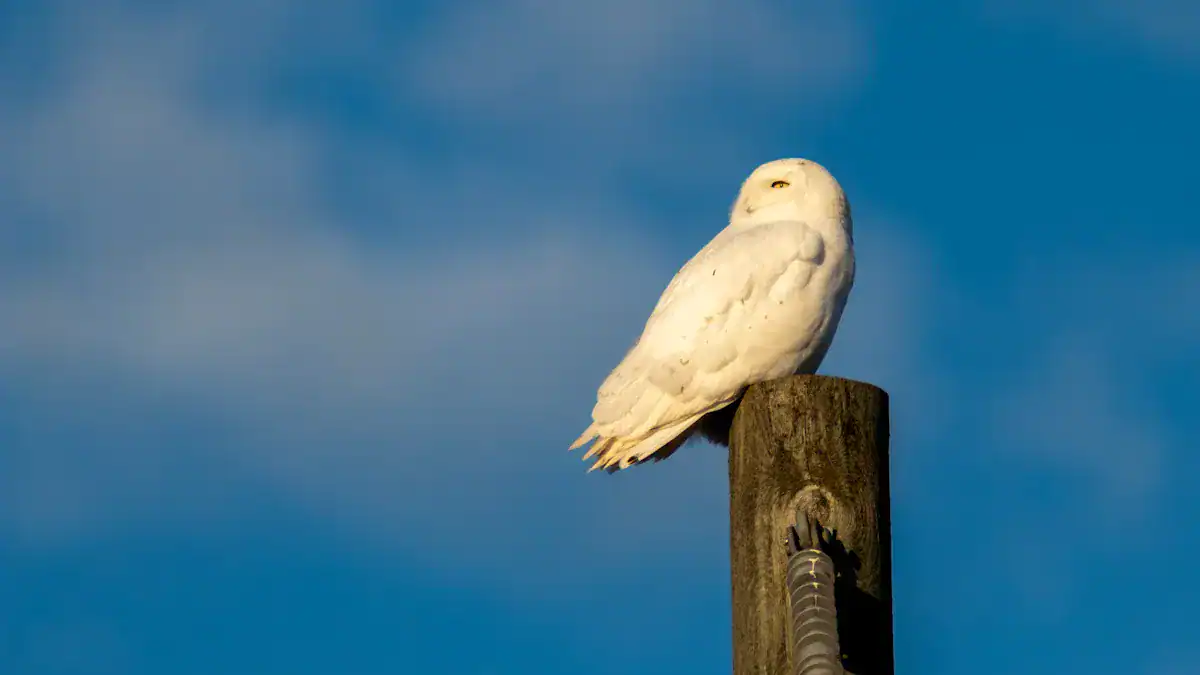
The snowy owl is a very large, white owl. It weighs more than any other North American owl. This bird has a round head without ear tufts. It possesses prominent yellow eyes and a black beak. Adult males are almost pure white. Females and immature birds are speckled with black or brown. Young males have a white bib and a spot on the back of the head. Dark brown barring fades with age, making them almost pure white. Females keep dark bars throughout their lives.
The whitest birds are always males. The most heavily barred ones are always females. All snowy owls have bright yellow eyes. Unique serrated primary flight feathers allow for silent flight. This owl has a zygodactyl foot arrangement. This means two toes point forward and two point backward. It can rotate its toes to an anisodactyl arrangement (three forward, one backward) when hunting. Its large, fixed eyes have a bony ring. The owl compensates with 14 neck vertebrae. This allows for 270-degree head rotation.
Calls
The snowy owl’s hoot is its closest vocalization to a song. Males primarily use hoots for territorial defense displays. These hoots typically sound like ‘hoo, hoo’. They can repeat up to six or more times in a row. Each hoot has a one-to-two-second interval. The last set of hoots is usually the loudest. These calls can have a ventriloquial quality.
This makes it seem as though the owl vocalizes from a different location. People can hear these hoots up to seven miles away on the tundra. Snowy owls also use whistles and hisses for defense. They make a clacking sound called bill snapping when agitated.
Habitat
Snowy owls live in open, treeless arctic tundra. They prefer wide-open spaces. During winter, they sometimes move south. They can appear in open fields, coastal dunes, and even airports. These areas mimic their natural treeless environment.
Behavior
This owl hunts during the day, unlike many other owls. It often perches on a low mound or post. It watches for prey. Its diet mainly consists of lemmings. It also eats other small mammals and birds. The snowy owl is a powerful hunter.
Barn Owl
Identification Features
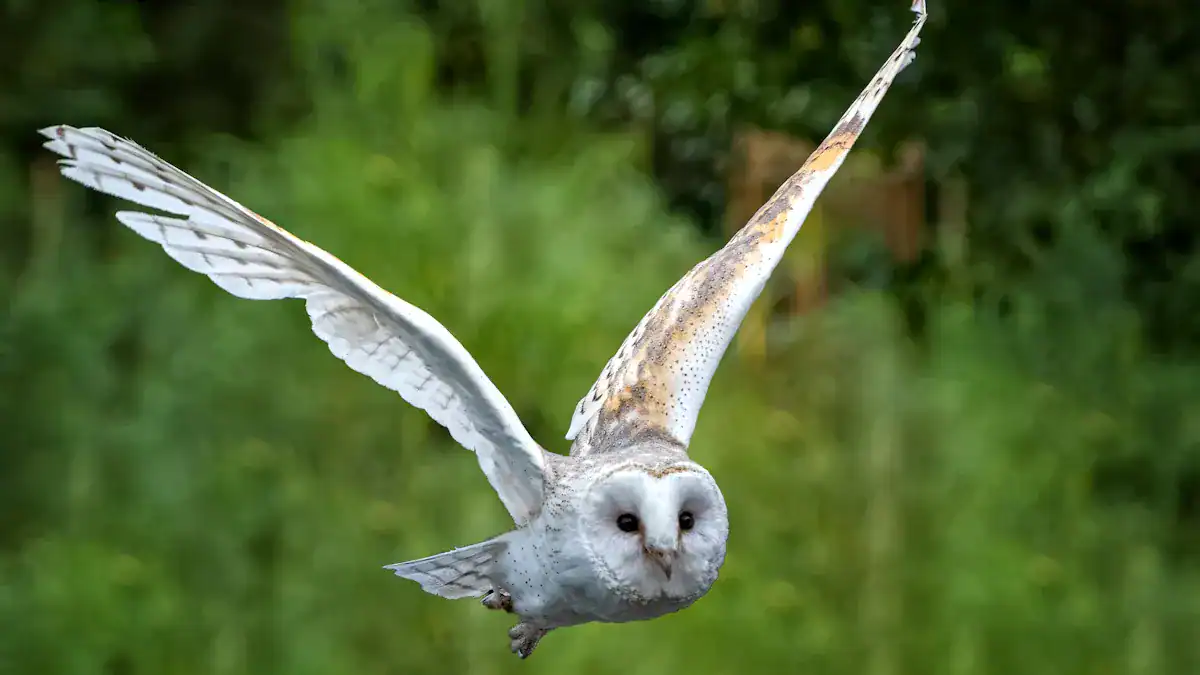
The Barn Owl is a medium-sized owl with a distinctive appearance. It has a large, rounded head and lacks ear tufts. Its most notable feature is its heart-shaped face, which is usually bright white. The underparts are typically cream-white, sometimes with tiny blackish-brown speckles. Its back and head are light brown with variable black and white spots.
The main wing and tail feathers are light brown with darker bands. Barn Owls have long legs sparsely feathered down to their gray toes. Females are often larger than males. They weigh around 570 grams compared to males at 470 grams. Females also have a slightly longer body length, from 34 to 40 cm, while males measure 32 to 38 cm. The wingspan for both sexes ranges from 107 to 110 cm. Females also tend to have more spots on their chest.
Calls
Barn Owls have a variety of unique vocalizations. They do not hoot like many other owls. Instead, they produce a range of sounds. Their calls include various screams, such as a drawn-out gargling scream for advertising or a series of harsh screams when distressed.
They also make high-pitched warning screams. Barn Owls use snores, primarily given by females and nestlings. They produce long, loud hisses to intimidate predators. Males make chirrups and twitters when delivering food. Females also twitter when feeding their young. Nestlings twitter when uncomfortable or quarreling.
Habitat
Barn Owls prefer open country. They live in grasslands, marshes, and agricultural fields. They often choose areas with scattered trees or old buildings for nesting and roosting. These owls frequently inhabit barns, silos, and abandoned structures, which gives them their name. They are found across a wide range of climates globally.
Behavior
Barn Owls are primarily nocturnal hunters. They have exceptional hearing and vision, which helps them locate prey in the dark. They hunt small mammals like voles and mice. They fly silently over fields, then swoop down to catch their prey. Barn Owls often nest in tree cavities, cliff ledges, or man-made structures.
Burrowing Owl
Identification Features
The burrowing owl is a pint-sized bird. It averages nine inches in height. Its wingspan reaches 21 inches. This makes it one of Florida’s smallest owls. Its plumage is sandy brown. This color provides excellent camouflage. Brown dorsal feathers have white spots. Its white underside features brown bar-shaped spots. The burrowing owl has bright yellow eyes. A white chin stands out. It possesses unusually long legs. These legs provide additional height for a better view. This owl lacks the ear tufts common in other woodland owls.
Calls
Burrowing owls use a range of vocalizations. Adults make calls for territorial claims. They also use them for courtship. They express alarm with specific calls. Young owls beg for food. They can produce a raspy scream. This scream mimics a rattlesnake’s rattle. It potentially deters predators. Beyond their double hoots, burrowing owls are known for a long, rattling hiss. This sound mimics a rattlesnake’s warning. It can scare away unwanted visitors from their burrows.
Habitat
Burrowing owls prefer open, treeless areas. They live in grasslands, prairies, and deserts. They often inhabit agricultural fields and golf courses. These owls use burrows dug by other animals. Prairie dogs, ground squirrels, and badgers create these burrows. The owls adapt these burrows for their own use.
Behavior
Burrowing owls are active during the day and night. They hunt insects, small mammals, and reptiles. They often stand at the entrance of their burrow. They watch for prey. These owls are unique because they live underground. They nest and raise their young in these burrows. They are social birds. They often live in colonies.
Long-eared Owl
Identification Features
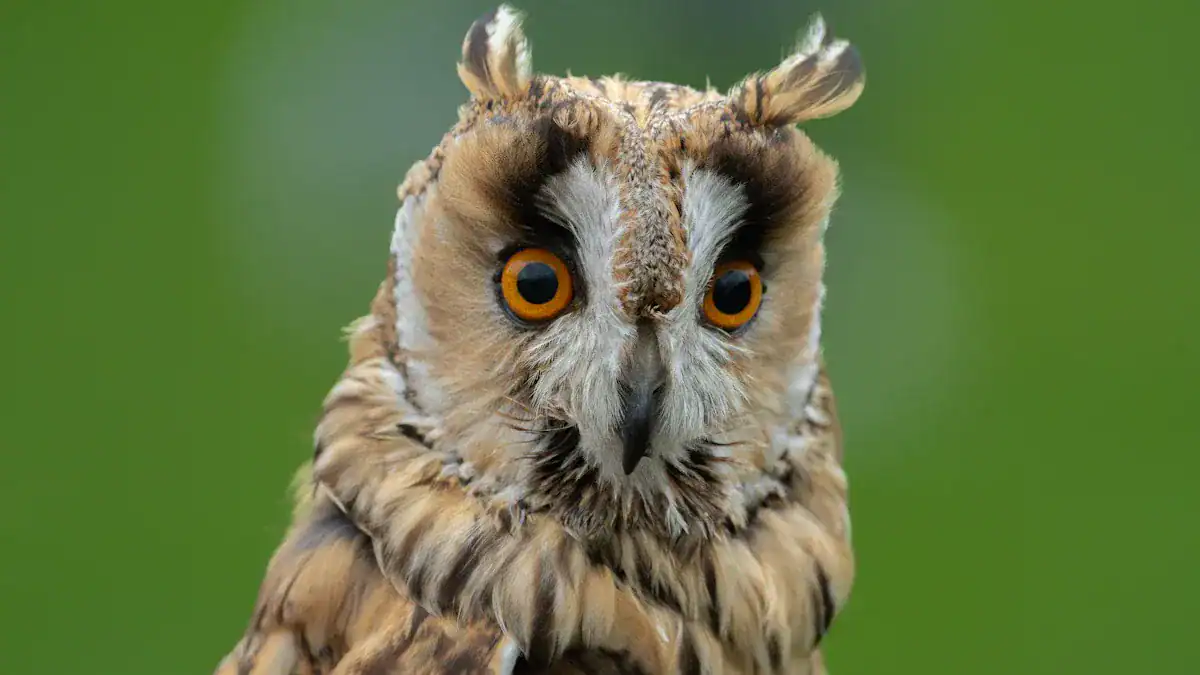
The Long-eared Owl is a medium-sized bird. It appears much smaller and slimmer than a Great Horned Owl. Many consider it North America’s most slender owl. Females are generally larger than males. Females weigh between 260 and 435 grams and measure 27 to 40 centimeters. Males weigh 220 to 305 grams and are 35 to 37.5 centimeters long. Its wingspan ranges from 90 to 100 centimeters. This owl has long, close-set ear tufts. It holds these tufts flat against its head during flight. Its face is orange with blackish highlights around the eyes. Two vertical white lines appear between its yellow eyes. The plumage is brownish-gray with vertical streaks.
This differs from the Great Horned Owl’s horizontal bars. Its undersides show dark streaking and barring, creating a checkered pattern. This owl can elongate its body when threatened. It raises its ear tufts and compresses its plumage. This makes it resemble a tree limb, aiding camouflage in dense foliage.
Calls
Long-eared Owls have distinct vocalizations. They often make a low, mournful hoot. This hoot repeats at regular intervals. They also produce a variety of barks, squeals, and cat-like meows. Males use a soft, drawn-out hoot to attract mates. Females make a high-pitched “whee-oo” call. Young owls produce a squeaky begging call.
Habitat
Long-eared Owls prefer dense coniferous or mixed forests. They often live near open country for hunting. They use abandoned nests of other large birds, such as hawks or crows. These owls typically inhabit areas with thick undergrowth. This provides good cover for roosting during the day. They are found across North America, Europe, and Asia.
Behavior
This owl is primarily nocturnal. It hunts mostly at night. Its diet includes small mammals like voles and mice. It also eats small birds. The Long-eared Owl hunts by flying low over open fields. It listens for prey. It then swoops down silently to capture its meal. These owls are quite secretive. People rarely see them during the day. They roost communally in winter.
Short-eared Owl
Identification Features
The Short-eared Owl is a medium-sized owl. It has a round head and small ear tufts. These tufts are often hard to see. Its plumage is streaky brown on top. The owl has a pale belly with dark streaks. Its face is pale with yellow eyes. Dark patches surround its eyes. This gives it a masked appearance. The Short-eared Owl measures about 13 to 17 inches long. Its wingspan can reach 33 to 40 inches. It has long wings. Its flight is buoyant and moth-like. This owl often flies low over open fields.
Calls
Short-eared Owls make various sounds. They produce a series of hoarse barks. These barks sound like “wak-wak-wak.” Males also make a low, soft “toot-toot-toot” call during courtship flights. When alarmed, they hiss. Young owls make a high-pitched begging call. These vocalizations help identify the owl in its open habitat.
Habitat
Short-eared Owls prefer open country. They live in grasslands, marshes, and tundra. They also inhabit agricultural fields and coastal dunes. These owls need wide-open spaces for hunting. They often choose areas with tall grasses or low vegetation. This provides cover for nesting and roosting. Unlike many other owls, they do not rely on trees.
Behavior
This owl is active during the day. It hunts most often at dawn and dusk. It preys on small mammals. Voles and mice are common food sources. The owl flies low over fields. It listens for prey. Then it swoops down to catch its meal. Short-eared Owls nest on the ground. They build a simple nest in a shallow depression. They often roost on the ground as well.
Northern Saw-whet Owl
Identification Features
The Northern Saw-whet Owl is a small, compact owl. It stands about seven inches tall. This makes it the smallest owl east of the Mississippi River. Males weigh around 75 grams, and females weigh about 100 grams. Its body length ranges from 18 to 21.5 centimeters. The wingspan of adults is 45 to 60 centimeters. This owl has a large, round head without ear tufts. Its plumage is mottled brown and white. Fine white streaks appear on its head.
A distinctive white ‘V’ marking sits between its yellow eyes. The facial disk is pale and whitish. Its bill is dark-colored. The owl has heavily feathered legs and feet. Its tail features three bars. Juveniles look different. They are chocolate-brown with large white spots above their bills. These spots extend over their eyes. This distinct plumage disappears by the end of their first summer.
Calls
Northern Saw-whet Owls have unique vocalizations. They produce chatters and insect-like buzzing sounds. These sounds resemble a cricket or grasshopper. They can also sound like the twittering of Chimney Swifts, but drier. These calls can last several seconds. Some chips sound like insects or rodents. They are sharp, dry notes. The owl often gives these contact notes from higher perches. On rare occasions, especially in winter, Northern Saw-whet Owls make bill snaps. These sounds are like marbles or rocks clicking together. They occur in short series.
Habitat
Northern Saw-whet Owls prefer dense coniferous or mixed forests. They often live in areas with thick undergrowth. This provides good cover for roosting during the day. They use tree cavities or old woodpecker holes for nesting. These owls are found across North America, from southern Canada to central Mexico.
Behavior
This small owl is primarily nocturnal. It hunts mostly at night. Its diet includes small mammals like mice and voles. It also eats large insects and small birds. The Northern Saw-whet Owl often perches silently. Then it swoops down to catch its prey. It is quite secretive. People rarely see it during the day.
Boreal Owl
Identification Features
The Boreal Owl is a small, compact owl. It has a large, round head. This owl does not have ear tufts. Its plumage is mottled brown and white. It has many white spots on its head and back. Its facial disc is prominent. It is whitish with dark brown around its bright yellow eyes. The Boreal Owl measures about 8 to 11 inches long. It weighs between 3.5 and 7 ounces. Its wingspan is typically 20 to 24 inches. Its small size helps it hide in dense forests.
Calls
The Boreal Owl has a distinctive call. It makes a series of soft, rapid hoots. These hoots sound like “hoo-hoo-hoo.” They are often described as a “flute-like” or “staccato” sound. The calls can carry far through the quiet forest. Males use these calls to attract mates. They also use them to mark their territory. This owl also makes chattering sounds when agitated.
Habitat
Boreal Owls live in dense coniferous forests. They prefer northern regions. These areas include spruce, fir, and pine trees. They often choose forests with old growth. These forests provide many tree cavities. They use these cavities for nesting and roosting. They are found across North America, Europe, and Asia.
Behavior
This owl is primarily nocturnal. It hunts mostly at night. Its diet includes small mammals. Voles and mice are common prey. It also eats large insects and small birds. The Boreal Owl often perches silently. It listens for prey. Then it swoops down to catch its meal. It is a very secretive bird. People rarely see these owls during the day.
Great Gray Owl
Identification Features
The great gray owl stands as the largest species of owl globally by length. It measures nearly three feet long. Its wingspan can reach 4.5 feet. This impressive bird has a large, rounded head with a gray face. Yellow eyes feature darker circles around them. Its underparts are light with dark streaks. The upper parts are gray with pale bars. This owl does not have ear tufts. It possesses the largest facial disc of any raptor. A white collar or ‘bow-tie’ sits just below its beak. Its long tail tapers to a rounded end. Females average 72 cm (28 in) in length, while males average 67 cm (26 in). Wingspans average 142 cm (4 ft 8 in) for females and 140 cm (4 ft 7 in) for males. Much of its apparent size comes from fluffy feathers, a large head, and the longest tail among extant owls, not body mass.
Calls
Great gray owls have distinct vocalizations. During the breeding season, from March to July, both males and females produce a low-pitched series of resonating ‘hoos’. These hoots last for 6–8 seconds. Approximately 30 seconds pass between calls. The male’s vocalization is lower pitched than the female’s. Adults also emit a soft double hoot. They use this call when defending their territories or delivering food.
Habitat
Great gray owls prefer dense coniferous forests. They often live in boreal forests and mountainous regions. These areas provide good cover and abundant prey. They typically inhabit areas with open meadows or clearings for hunting. They are found across North America, Europe, and Asia.
Behavior
This owl is primarily crepuscular and nocturnal. It hunts mainly at dawn, dusk, and night. Its diet consists mostly of small mammals, especially voles. It uses its exceptional hearing to locate prey under snow. Then it plunges headfirst to capture its meal. Great gray owls are quite secretive. People rarely see them.
Spotted Owl
Identification Features
The Spotted Owl is a medium-sized forest owl. It has a round head and lacks ear tufts. Its plumage is dark brown with distinct white spots on its head, back, and belly. The owl’s facial disc is prominent, and it has dark brown eyes. A white X-shape often appears between its eyes. This owl measures about 17 to 19 inches long. Its wingspan can reach 40 to 45 inches. Its dark coloration helps it blend into the shadows of dense forests.
Calls
Spotted Owls have a distinctive hooting call. They often produce a series of four notes. This sounds like “hoo-hoo-hoo-hooo.” The last note is usually longer. Males and females use these calls to communicate with each other. They also use calls to defend their territory. Other vocalizations include barks, whistles, and hisses, especially when agitated.
Habitat
Spotted Owls prefer old-growth forests. They live in dense, mature woodlands with large trees. These forests often have a multi-layered canopy. They also feature abundant dead wood and tree cavities. These owls typically inhabit coniferous or mixed-conifer forests. They require undisturbed areas for nesting and hunting. Their range includes western North America, from British Columbia to Mexico.
Behavior
This owl is primarily nocturnal. It hunts mainly at night. Its diet consists mostly of small mammals. Flying squirrels, woodrats, and voles are common prey. The Spotted Owl often perches silently on a branch. It then swoops down to catch its prey. They nest in tree cavities, broken-top trees, or on cliff ledges. They are known for their territorial nature.
Elf Owl
Identification Features
The Elf Owl is the smallest owl in the world. It measures only about 5 to 6 inches long. This tiny owl weighs around 1.4 ounces. It has a round head and no ear tufts. Its plumage is grayish-brown with fine streaks. This coloration provides excellent camouflage against desert plants. White eyebrows sit above its bright yellow eyes. A white border outlines its facial disc. Its short tail and relatively long legs are also notable. This owl’s small size helps it hide effectively in dense desert vegetation.
Calls
Elf Owls make a distinctive call. They produce a series of high-pitched, yelping notes. This sounds like “chick-chick-chick-chick.” They also make soft whistles and chattering sounds. Males use these calls to attract mates. They also use them to defend their territory. People often hear these vocalizations at dusk and dawn. The calls can carry a surprising distance for such a small bird.
Habitat
Elf Owls live in arid desert regions. They prefer areas with saguaro cacti or other large trees. These plants provide essential cavities for nesting and roosting. They also inhabit riparian woodlands and canyons. These areas offer a mix of dense cover and open spaces for hunting. This owl is found in the southwestern United States and Mexico. Its range extends into parts of Central America.
Behavior
This owl is strictly nocturnal. It hunts mainly at night. Its diet consists mostly of large insects. Moths, crickets, and beetles are common prey. It also eats scorpions and small lizards. The Elf Owl often perches silently on a branch. It then swoops down to catch its prey. It nests in old woodpecker holes. These holes are often found in saguaro cacti. They also use cavities in utility poles or deciduous trees. These tiny owls are quite secretive. They are difficult to spot during the day.
This owl identification chart helps you discover the joy of spotting these magnificent birds. Applying this knowledge, you embark on rewarding adventures. Always practice responsible birdwatching, respecting wildlife, and minimizing disturbance to these birds. Many factors threaten owl populations. Collisions with vehicles, poisoning from rodenticides, and habitat loss impact these birds. Hunting, lack of prey, and diseases also contribute to their decline. Conservation efforts protect these vital predators. Share your sightings and continue learning about every owl.