
Imagine spotting vibrant red birds in Pennsylvania! This state boasts a remarkable avian diversity, with over 400 bird species recorded. You can easily find the bold Northern Cardinal, the elusive scarlet tanager, and the cheerful House Finch. This guide provides clear identification tips for these stunning scarlet and crimson bird species, including the specific scarlet tanager species. It helps you distinguish each beautiful tanager.
Key Takeaways
Northern Cardinals are easy to spot. They have a crest and a black mask. Males are bright red all year.
Scarlet Tanagers are summer visitors. Males are bright red with black wings and tail. They live in forests.
House Finches have streaky red and brown bodies. They often visit bird feeders. Males have red on their face and chest.
Other red birds like Purple Finches and Red-bellied Woodpeckers also live in Pennsylvania. They have unique red markings.
You can attract red birds to your yard. Offer seeds and fresh water. Use binoculars to see them better.
Northern Cardinal: Year-Round Red
Key Identification Features
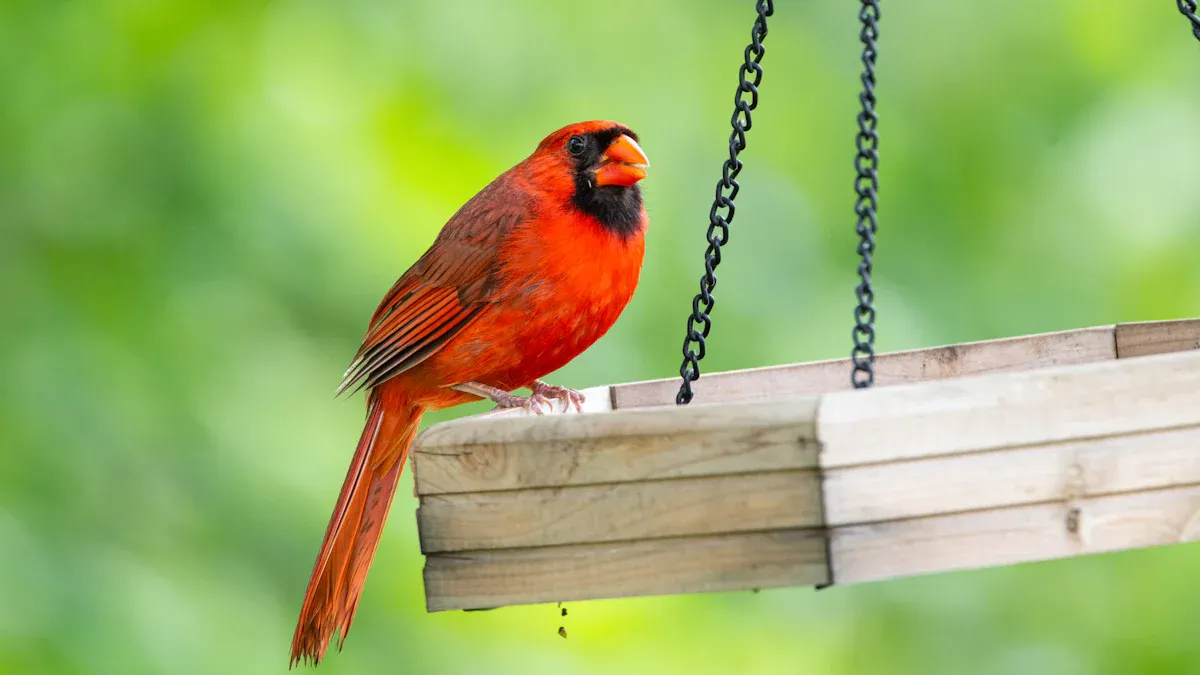
The male Northern Cardinal is easy to spot. It has a distinctive crest and vivid red feathers. People often call it a ‘Redbird.’ Adult males are a brilliant crimson red. They have a black face mask. This mask covers their eyes and goes down to their upper chest. The red color on their back and wings is a little duller. Both male and female cardinals have prominent crests. Their beaks are bright coral-colored and cone-shaped. These strong beaks help them crack seeds. The red color comes from pigments in their food. These are carotenoid pigments. Males can change these pigments to make different colors. For example, eating only yellow pigments can result in a pale red color. Some rare cardinals are ‘yellow morphs.’ They do not have the enzyme to make red pigments. This gives them yellow beaks and feathers. They still have the black face mask.
Characteristic | AHY Male Northern Cardinal | HY Male Northern Cardinal (early-mid fall) |
|---|---|---|
Body Plumage | Entirely red, except for a black facial mask. Color may vary with lighting. Feathers on back and wings may have gray edging, but no contrasting brown juvenile feathers. | Primarily red, but may have patches of retained brown juvenal feathers (if preformative molt is incomplete), most commonly on wings, but also on back and tail. |
Wing | Entirely red, with no molt limits. | May have patches of retained brown juvenal feathers. |
Tail | Uniformly brick red. | May have patches of retained brown juvenal feathers. |
Bill | N/A | May have dusky patches. |
Iris | N/A | Tends to remain more grayish than brown until late in the year. |
Female Northern Cardinals also have a crest. Their feathers are reddish-brown. They have red accents on their wings and tail. This helps with their identification.
Size and Shape
Northern Cardinals are medium-sized birds. They have a stout bill. You can measure their size to help you identify them.
Measurement | Value (cm) | Value (inches) |
|---|---|---|
Length Range | 20.9 – 23.5 | 8.23 – 9.25 |
Average Wingspan | 30.5 | 12.01 |
Here is another way to look at their size:
Measurement | Range (inches) | Range (cm) |
|---|---|---|
Body Length | 8.3 – 9.4 | 21 – 24 |
Wingspan | 9.8 – 12.2 | 25 – 31 |
Habitat and Behavior
Northern Cardinals love brushy areas. These areas have many shrubs and small trees. This is why you often see them in neighborhoods. Your backyard might have them if you have many shrubs. Female cardinals build their nests in small branches. They choose saplings or shrubs for their nests. This preferred habitat makes them common visitors to feeders.
Both male and female cardinals sing. Their song is a loud series of clear whistles. These whistles often go down in pitch. They can also be two-parted. The song often gets faster. It ends with a slow trill. These songs usually last 2 to 3 seconds. They can sound like “cheer, cheer, cheer” or “birdie, birdie, birdie.” Males sing all year. They sing most in spring and early summer.
Scientists have found at least 16 different calls. The most common call is a loud, metallic “chip.” Cardinals use this call to warn others. They warn about intruders or nearby predators. Females use it when they go to their nests. Both sexes use it when they bring food to their young. They also use it to encourage young birds to fly. A softer “took” note might mean one bird is about to feed the other. Northern Cardinals produce a clear, repetitive whistling song. You often hear it early in the morning. It sounds like “cheer, cheer, cheer” or “birdy, birdy, birdy.” Both males and females sing. This is unusual for songbirds. Their most common call is a loud, metallic chipping sound. They use it during breeding season. It helps them defend their territory from predators. Cardinal pairs also sing together. This strengthens their bond. Females sing from the nest. They signal the male to bring food. Males sing during courtship. They also alert the female in the nest about predators.
Distinguishing Features
You can easily tell Northern Cardinals apart from other red birds. Look for their unique features.
Feature | Northern Cardinal | Other Red Birds (General) |
|---|---|---|
Crest | Has a noticeable crest on the head | Most red birds lack a crest (e.g., Scarlet Tanager, Summer Tanager) |
Face Mask | Prominent black mask around the beak (males) | Usually no distinct black mask (e.g., Scarlet Tanager, Summer Tanager) |
Beak | Short, thick, and orange, perfect for cracking seeds | Can be thin or thick, varies by species; not always orange |
Color | Bright red (males), brownish with reddish accents (females) | Varies (scarlet, crimson, or orange-red); can be all-red (e.g., Summer Tanager) but without other cardinal features |
The crest and the black mask on the male are very important. These features make the Northern Cardinal unique. Other red birds usually do not have both.
Scarlet Tanager: Summer Visitor
Identifying Scarlet Tanager
You might see a flash of brilliant red in the summer woods. That is likely a scarlet tanager. This bird is a true jewel of Pennsylvania’s forests. Spotting a scarlet tanager is a memorable experience for any birdwatcher.
Scarlet Plumage Details
Male scarlet tanagers are stunning during breeding season. Their body plumage, except for their wings and tail, is a vibrant scarlet red. This scarlet color is often very deep. Their flight feathers and wing coverts are uniformly black. Their tail feathers are also uniformly blackish. Male scarlet tanagers exhibit blood-red bodies. These contrast sharply with their jet-black wings and tail during the summer breeding season.
Female scarlet tanagers look quite different. You might find her olive-yellow feathers easy to miss. She has soft olive upperparts with yellow underparts. Her wings are slightly darker, giving her a shaded look.
Feature | Female Scarlet Tanager |
|---|---|
Plumage | Olive-green top; yellow below |
Color | Olive on top, yellow underneath |
Wings & Tail | Darker, yellow-olive |
Face & Head | Slight greenish hue near the eyes |
Overall Vibe | Subtle and forest-toned |
The vibrant scarlet coloration in male scarlet tanagers comes from carotenoid compounds. These compounds come from the bird’s diet. The bird processes them into pigments. These pigments then go into their growing feathers. This gives them their characteristic red hue. A gene called CYP2J19 is very active in red-feathered birds. This gene helps them change yellow carotenoids into red ketocarotenoids. These ketocarotenoids make their feathers glow red. This gene also helps detoxify harmful chemicals. This means a brighter red bird might be healthier. This makes them more attractive to mates.
Habitat and Behavior
Scarlet tanagers are long-distance migrants. They spend their summer, which is their breeding season, in the Eastern United States. This includes Pennsylvania. They fly across the Gulf of Mexico. Their migration happens mostly at night. They winter in South America. You will find them in mature deciduous forests. They often stay high in the canopy. This makes them hard to spot. The scarlet tanager is largely insectivorous. They eat mostly moth and butterfly larvae. They also eat various adult insects. They find their food by hovering and picking up prey.
Unique Characteristics
Scarlet tanagers have some distinct behaviors. They mob most predators. They dive and swoop around them while calling. However, they become quiet and watchful when they see American crows and merlins. They try to be inconspicuous then.
Trait | Scarlet Tanager | Western Tanager |
|---|---|---|
Habitat Preference | Canopy dwellers, deciduous forests | Open coniferous or mixed forests |
Mating Behavior | Monogamous for a season; males use vibrant plumage to attract females; both parents rear chicks | Male chases female for courtship; nesting in conifers; less documented parental roles |
Dietary Focus | Beetles and ants | Bees and wasps |
This tanager spends much time skulking among wide leaves in the forest canopy. This makes them hard to see. You will hear their song. It is a burry, rambling song. They also make a distinct, harsh ‘chick-burr’ call. This call helps you identify this bird. They lack a crest. Their males have solid black wings. These features help you distinguish them from similar species.
House Finch: Streaky Red
Key Identification Features
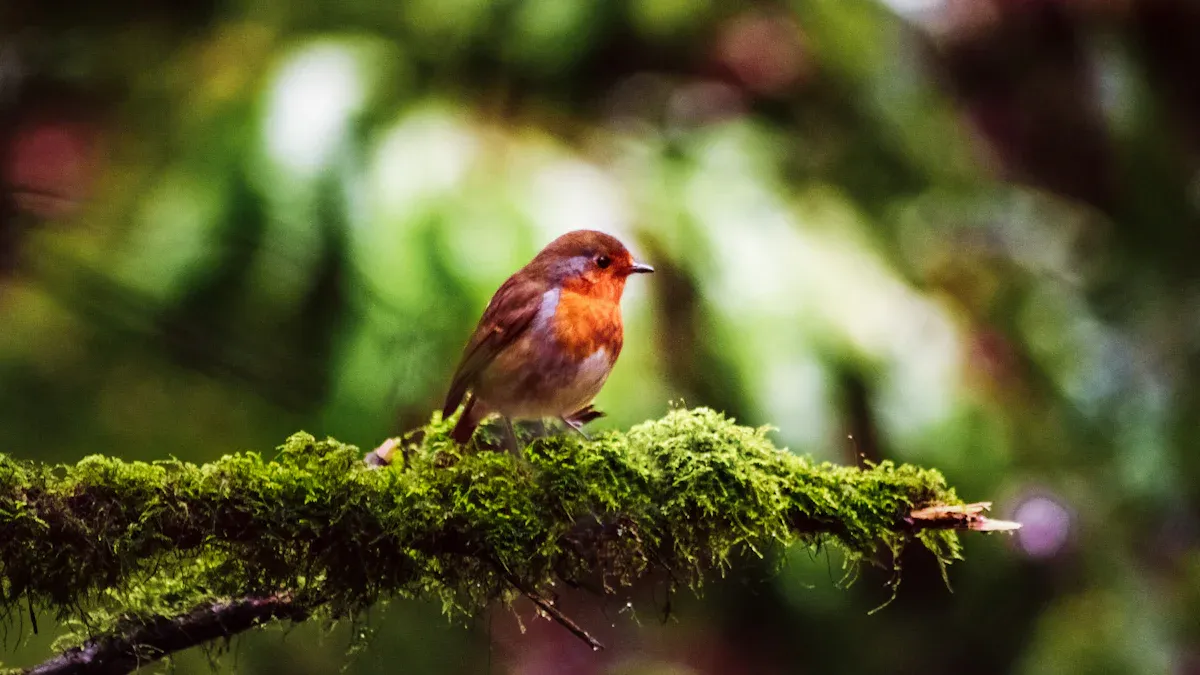
You can easily spot a House Finch by its distinctive coloring. Male House Finches show rosy red coloration around their face and upper breast. This red color also appears on their eyebrow and throat. Their cheeks are brownish. You will notice streaks down their belly and on their flanks. Their back, belly, and tail are streaky brown. When they fly, you can see a conspicuous red rump. They have a thick bill with a curved profile. Female House Finches look different. They are streaky brown overall. They lack the bright red patches of the males.
Size and Shape
House Finches are small birds. They have fairly large, blunt, and rounded beaks. Their beaks lack a sharp tip. You will also notice their somewhat long, flat heads and short wings. This makes their tail appear long. Their tail has a relatively shallow notch.
Length: 12.5 to 15 cm (5 to 6 in)
Wingspan: 20 to 25 cm (8 to 10 in)
Body mass: 16 to 27 g (9⁄16 to 15⁄16 oz)
Habitat and Behavior
House Finches are very adaptable. You often find them in urban and suburban areas. In the eastern United States, they live almost exclusively in places with buildings and lawns. They rarely venture far from these developed areas. They are common visitors to bird feeders. They sing a cheerful, warbling song. This song often ends with a rising “cheer.” During courtship, males perform a feeding display. The female gently pecks at his bill and flutters her wings. The male then simulates regurgitating food before actually feeding her. House Finches build nests in various trees and on man-made structures. They use buildings, vents, ledges, and hanging planters.
Distinguishing Features
You can tell House Finches apart from similar species. Look for their streaky body. Their red color is less intense than a Northern Cardinal or a Scarlet Tanager. House Finches are slender. Their red is more orange-red. They have two thin, white wing bars. Their tail is long with a shallow notch. Their beak is small and bulbous with a curved top. Male House Finches always have a slice of brown on their face and brownish wings with tan wing bars.
Other Red-Tinged Species
Pennsylvania offers more than just the classic red birds. You might also encounter other species with hints of crimson or rosy hues. These birds add to the state’s vibrant avian tapestry. You can learn to identify them too.
Purple Finch
You might spot a Purple Finch. Male Purple Finches show a rosy red color. This color covers their head, breast, and back. It looks like a raspberry stain. They appear less streaky than House Finches. Their rosy red plumage helps you tell them apart.
Feature | Male Purple Finch | Male House Finch |
|---|---|---|
Color | Rosy red, like a raspberry stain | Reddish-orange, streaky |
Back | More uniform, blurry dark red-brown streaks | Distinct dark streaks on pale pinkish |
Underparts | Tends to have a buffy belly with red smudges | White with pink smudges, faint streaks |
Streaking | Less streaky overall | More noticeable streaking on flanks |
Female Purple Finches have a brown and white streaky pattern. They have a strong facial pattern. You will see a distinct white stripe above their eye.
Red-bellied Woodpecker
You can also find the Red-bellied Woodpecker. This bird has a striking black-and-white barred pattern on its back. It also has a pale belly.
Males: They feature a red crown and nape.
Females: They have a red nape but lack the red crown.
Immatures: They appear grayer than adults. They do not have any red on their heads.
General Appearance: These woodpeckers often look pale overall. You will see a boldly striped black-and-white back. They have noticeable red on the cap and nape. White patches near the wingtips are visible during flight.
Size: They are about 9.4 inches (24 cm) long. They have a sleek, round head.
You might notice a subtle red wash on their belly. This wash is often hard to see. It gives them their name.
Spotting Red Birds in Pennsylvania
Finding red birds in Pennsylvania is a rewarding experience. You can increase your chances by knowing when and where to look. Also, having the right tools helps.
Best Times and Locations
The best times to spot red birds are usually at dawn and dusk. Birds are most active then. You can find them at bird feeders, especially in your backyard. Forest edges are also great places. These areas offer both cover and food. Different red birds prefer specific natural areas.
Bird Species | Preferred Natural Areas |
|---|---|
Scarlet Tanager | Deciduous forests, parks, pine-oak woodlands, suburban areas with large, tall trees |
House Finch | Urban and suburban areas, backyards, parks, around buildings |
Purple Finch | Backyard bird feeders (especially in winter), areas with conifer trees |
Essential Gear
You need a few items to make your birdwatching successful. Binoculars are very important. They help you see details from a distance. Look for binoculars with good optical quality. They should give you bright, clear views. An 8x magnification is often best for general birdwatching. This gives you a wide view and a steady image. Make sure they are waterproof and fog-proof. This protects them in outdoor conditions. A good field guide for Pennsylvania birds is also helpful. It lets you confirm what you see.
Attracting Red Birds
You can bring red birds in Pennsylvania right to your yard. Providing food and water works well. For Northern Cardinals, black oil sunflower seeds are highly recommended. They also enjoy safflower seeds and peanut bits.
Black oil sunflower seed
Safflower seed (especially golden safflower)
Peanut bits
Cracked corn
Birds need fresh, clean water every day. This is for drinking and bathing. A birdbath is a great addition. Make sure your birdbath is 1 to 3 inches deep. This depth is perfect for songbirds. Clean your birdbath regularly. Use dish soap or a vinegar solution. In cold weather, a heated birdbath provides ice-free water. This is crucial when snow is not on the ground.
You will find great joy identifying red birds in Pennsylvania. This guide helps you distinguish the Northern Cardinal by its crest and black mask. You can spot the vibrant scarlet tanager with its striking scarlet body and black wings. The House Finch shows a streaky red pattern. Use this guide to enhance your birding and appreciate every beautiful bird you see.
FAQ
What is the easiest way to tell a male Northern Cardinal from a male Scarlet Tanager?
You can easily tell them apart. A male Northern Cardinal has a crest on its head and a black mask on its face. A male Scarlet Tanager has no crest. It also has solid black wings and tail, contrasting with its red body.
What do female House Finches look like?
Female House Finches are streaky brown birds. They do not have the bright red patches that males show. You will see streaks all over their body. They have a plain face.
What is the main difference between a Purple Finch and a House Finch?
Male Purple Finches have a rosy red color. It looks like a raspberry stain. They appear less streaky than House Finches. Male House Finches show a reddish-orange color. They have more noticeable streaks on their body.
What do red birds eat at feeders?
Many red birds enjoy seeds. Northern Cardinals love black oil sunflower seeds and safflower. House Finches also eat black oil sunflower seeds. You can offer a variety of seeds. This attracts different red birds to your yard.