
Butterflies add immense beauty to our world. They also play a vital role in nature. Pollination by insects, including butterflies, contributes an economic value of between $235 billion and $577 billion annually to global food production. You can easily observe these amazing creatures. This butterfly identification chart guides you through 15 of the most beautiful butterflies. You will learn to recognize different butterfly species. Even casual window gazing becomes more exciting with this chart. It enhances your discovery of each unique butterfly.
Key Takeaways
Butterflies are beautiful and important for nature. They help plants grow by moving pollen.
You can identify butterflies by looking at their wing colors, patterns, and shapes. Also, notice where they live and how they fly.
This guide shows 15 different types of butterflies. It helps you learn their special features and where to find them.
To help butterflies, plant native flowers and avoid bug sprays. This makes your garden a safe home for them.
Using Your Butterfly Identification Chart
This butterfly identification chart helps you recognize different butterflies. You will learn to interpret visual cues and contextual details. This makes your observations more meaningful.
Key Identification Features
First, look closely at the butterfly’s wings. Note the overall size and shape. Observe the main colors. Are they bright, dull, or iridescent? Pay attention to specific patterns. These include spots, stripes, or eye-like markings. Each butterfly species has unique features. For example, some species have distinct bands on their wings. Others show intricate vein patterns. These details are crucial for accurate identification.
Observing Habitat and Behavior
Where you find a butterfly tells you a lot. Local habitat characteristics significantly influence butterfly diversity. For instance, sites with high canopy cover and many trees often have more butterflies. This is because shade helps with egg laying and larval development. Many factors influence butterfly-habitat associations. These include temperature, humidity, and light levels. The type of grassland and the richness of host plants also play a role.
Butterfly species occupy suitable habitats based on their specific needs. Some species thrive in open areas. Other species prefer closed-canopy forests. For example, restoration efforts in ponderosa pine forests showed more butterfly species and abundance in areas with increased light. This happened even when host plants were similar. Understanding habitat requirements and specialization is crucial for identifying butterflies. It also helps with conservation.
Tips for Accurate Identification
Always compare what you see to the images and descriptions in this butterfly identification chart. Take a quick photo if you can. This lets you examine details later. Note the butterfly’s flight pattern. Is it fast and erratic, or slow and gliding? Observe what plants it visits. This helps confirm its identity. Remember, practice improves your identification skills. You will soon recognize many beautiful butterflies.
15 Gorgeous Butterfly Species
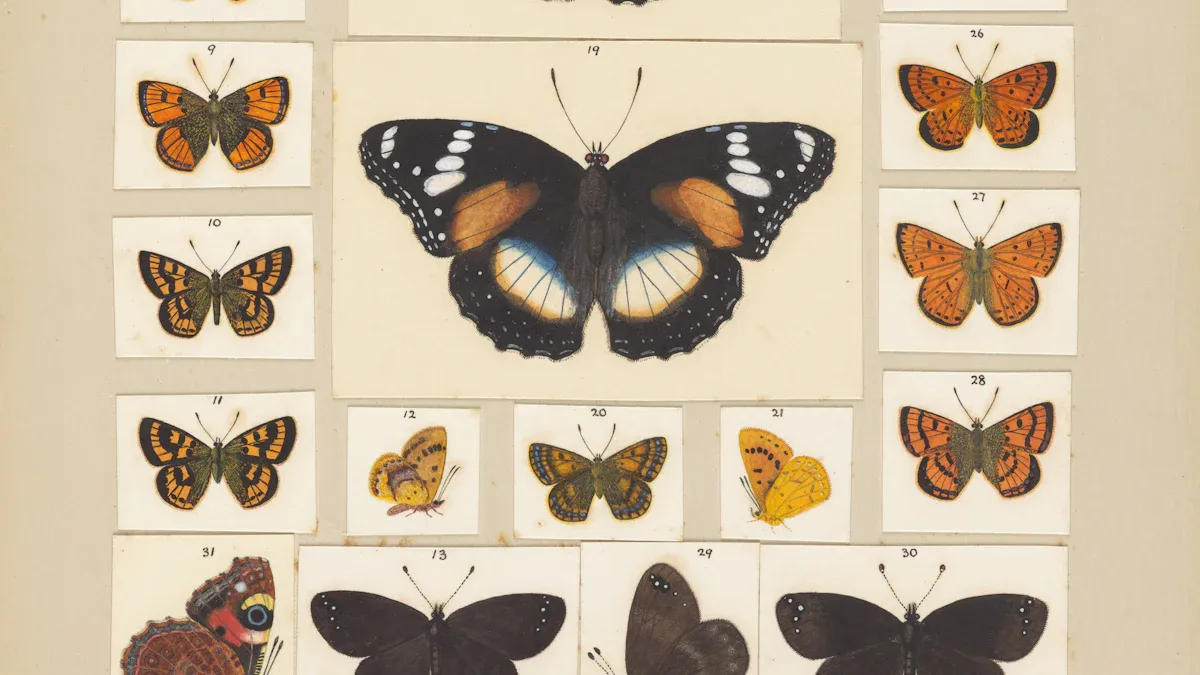
You are about to discover some of the most beautiful butterflies. This section of the butterfly identification chart will guide you through 15 stunning butterfly species. You will learn their unique features, where they live, and interesting facts about them.
Monarch Butterfly (Danaus plexippus)
The Monarch is one of the most recognized and most beautiful butterflies. You will easily spot its vibrant colors.
Key Identification Features: Adults are bright orange with black borders and black veins. Female monarchs have thicker veins than males. Male monarchs possess a swollen pouch on each hind wing. Their larvae have alternating black, white, and yellow bands along their entire length. They also have a pair of long black filaments projecting diagonally upward from both the front and hind ends. You can distinguish a Monarch from a Viceroy by its larger size and the absence of a black band across the Viceroy’s hindwing.
Typical Habitat/Range: Monarchs are found across North America. They undertake incredible migrations.
Interesting Facts: Eastern North American monarchs travel up to 3,000 miles to central Mexico for winter. Western North American monarchs undertake a shorter migration to the California coast. Some monarchs fly as far as 3,000 miles to reach their winter home. They can travel between 50-100 miles a day. It can take up to two months to complete their journey.
Painted Lady (Vanessa cardui)
The Painted Lady is a widely distributed butterfly species. You will find it in many parts of the world.
Key Identification Features: This butterfly exhibits orange-brown upper wings with darker bases. Its forewings feature a distinct white bar. The hindwings display a row of five small black dots. The underside of the wings presents patterns of brown, black, and gray, along with tiny submarginal eyespots. Unlike Monarchs, the Painted Lady’s wings lack black veins. Instead, they feature brown spots. When its wings are closed, you will see four ocelli, which are round, eye-like spots, on the back of its hind wings.
Typical Habitat/Range: You can find Painted Ladies in almost any open, sunny habitat. They are highly migratory.
Interesting Facts: This butterfly is one of the most widespread butterfly species in the world. It undertakes long-distance migrations.
Eastern Tiger Swallowtail (Papilio glaucus)
You will recognize the Eastern Tiger Swallowtail by its large size and striking yellow and black stripes.
Key Identification Features: These are large butterflies, typically yellow with black tiger stripes. Females can also be dark, almost entirely black, mimicking the Pipevine Swallowtail. They have two tails on each hindwing.
Typical Habitat/Range: You will find adults flying in forests, fields, and gardens. Their geographic range extends down to southern Florida. They thrive in many open and edge habitats, including parks and suburban residential areas. This butterfly is not a species of mature, closed-canopy forests.
Interesting Facts: This butterfly species likely benefited from land-clearing activities. These activities promoted early successional tree host plants like black and pin cherries and sassafras.
Red Admiral (Vanessa atalanta)
The Red Admiral is a common and easily identifiable butterfly. You will notice its bold markings.
Key Identification Features: It has a striking black, orange, and white wing pattern. The dorsal side shows dark wings with orange bands on the middle of the forewings and the outer edge of the hindwings. The distal ends of the forewings contain white spots. The ventral side shows brown wings with patches of red, white, and black. The hindwings on the ventral side feature a brown marbled pattern.
Typical Habitat/Range: You can find this butterfly in woodlands, gardens, and urban areas across North America, Europe, and Asia.
Interesting Facts: Red Admirals are known for their aggressive territorial behavior. They will often chase away other butterflies.
Common Buckeye (Junonia coenia)
You will easily identify the Common Buckeye by its conspicuous eyespots.
Key Identification Features: This medium-sized butterfly has a wingspan of 45 to 70 mm. Its upper surface is primarily brown with accents of orange, black, white, blue, and magenta. The forewing has two prominent orange bars and a broad white postmedian band. This band often encircles a single large eyespot and borders a smaller, more distal eyespot. Both of these forewing eyespots have a bluish center and are bordered by a distal orange mark. The hindwing displays two large eyespots and a broad orange submarginal band. The undersides of the hindwings vary seasonally. Wet season individuals have tan to brown ventral hindwings with more noticeable patterns. Dry season individuals are a rich reddish-brown.
Typical Habitat/Range: You will find them in open, sunny areas like fields, pastures, and gardens throughout the southern and eastern United States.
Interesting Facts: The bold color pattern and large, bold eyespots are key identification features. They help distinguish it from similar species like the White Peacock.
Mourning Cloak (Nymphalis antiopa)
The Mourning Cloak is one of the first butterflies you will see in spring.
Key Identification Features: It has dark, velvety maroon-brown wings with bright yellow borders and a row of iridescent blue spots just inside the border.
Typical Habitat/Range: You will find them in woodlands, forests, and parks across North America, Europe, and Asia.
Interesting Facts: Adult Mourning Cloaks can live for up to 10 months. This is an unusually long lifespan for a butterfly. They overwinter by hibernating in tree cavities, under loose bark, or in other sheltered locations like buildings. They use ‘antifreeze’ chemicals in their blood to survive the winter. You might see them emerge even before the snow has completely melted.
Question Mark (Polygonia interrogationis)
The Question Mark butterfly gets its name from a unique marking on its wings.
Key Identification Features: The underside of this butterfly’s wings features a color and textured appearance that provides camouflage. It resembles a dead leaf. A key identifying feature is the silver mark on the underside of the hindwing. This mark is broken into two parts—a curved line and a dot—forming a ‘?’ shape. Its wings are very angular, with wavy edges. Many people describe the wing shape as resembling angel wings. Question Mark butterflies have two tails, similar to swallowtails but shorter. The winter form has longer tails than the summer form. When open, both seasonal patterns feature a general reddish-orange to tannish-orange background color with dark brown spots. The summer form has a dark brown or black wash that can cover most of the lower/hind wings. The winter form lacks this dark wash.
Typical Habitat/Range: You will find them in woodlands, forest edges, and suburban gardens.
Interesting Facts: When its wings are closed, its camouflage is so effective that it looks just like a dead leaf.
Gulf Fritillary (Agraulis vanillae)
You will admire the bright orange and black patterns of the Gulf Fritillary.
Key Identification Features: This butterfly has bright orange wings with black markings and three white-rimmed black spots on the forewing. The underside of its hindwings is mottled brown and orange with large, reflective silver spots.
Typical Habitat/Range: You can find them in the southern United States, Central, and South America, often in open areas, gardens, and fields.
Interesting Facts: The host plant for Gulf Fritillary caterpillars is the passionflower vine. This includes species like Maypop (P. incarnata), Purple passionflower (Passiflora incarnata L.), Corkystem passionflower (Passiflora suberosa L.), and Yellow passionflower (Passiflora lutea L.).
Zebra Longwing (Heliconius charithonia)
The Zebra Longwing is easily recognized by its distinctive stripes.
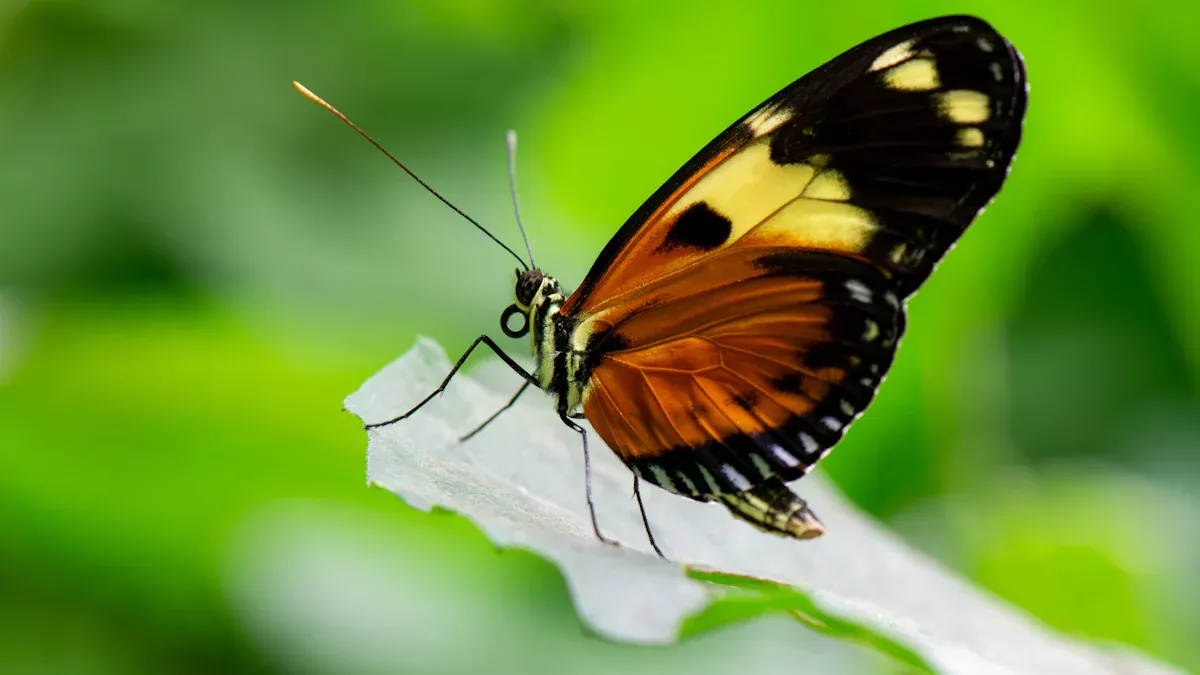
Key Identification Features: Its wings are black with bold, narrow yellow stripes, resembling a zebra. The lower wing surface has a similar pattern to the upper surface but is paler, with small red spots near the body. Its wingspan ranges from 72 to 100 mm. Its wings are long and narrow.
Typical Habitat/Range: You will find this butterfly in tropical and subtropical areas, especially in Florida, often in hammocks and gardens.
Interesting Facts: The Zebra Longwing has a slow and relaxed flight. Its black and white stripes act as a warning sign to predators, indicating its toxicity.
Pipevine Swallowtail (Battus philenor)
You will be captivated by the iridescent blue of the Pipevine Swallowtail.
Key Identification Features: This butterfly has iridescent blue-black wings on the upper side. The underside of the hindwings features a row of bright orange spots.
Typical Habitat/Range: You can find them in woodlands, meadows, and gardens throughout the eastern and southwestern United States.
Interesting Facts: The larvae ingest chemicals from their host plant, the pipevine. These chemicals, including aristolochic acids, make the caterpillar and adult butterfly toxic to eat. This toxicity, combined with their bright orange markings and blue iridescence, serves as a warning to predators.
Great Spangled Fritillary (Speyeria cybele)
The Great Spangled Fritillary is a large and beautiful butterfly. You will notice its distinctive silver spots.
Key Identification Features: This is the largest fritillary species, with a wingspan of 62 to 88 mm. Males have an orange upperside with black patterning. Females have similar patterning but are much browner overall with more black in the outer margin. The forewing underside is yellowish-orange with black markings. The hindwing underside is dark brown with a wide tan submarginal band and silver spots. Both sexes have scalloped forewings and hindwings. You will see black spots on the upperside of their wings and silver spots on the underside.
Typical Habitat/Range: You can find them in open woodlands, meadows, and fields across much of North America.
Interesting Facts: You can distinguish it from other large fritillaries by its large size and the absence of a black spot near the base of the forewing upperside.
American Lady (Vanessa virginiensis)
The American Lady is a charming butterfly. You will appreciate its unique markings.
Key Identification Features: This butterfly has less pointed wings compared to the Painted Lady. It typically features a small white spot in the orange cell near the upper wing margin. Its black median marks are usually not connected. The underside of its hindwing has a complex pattern of olive, black, and white, with two large blue eyespots near the outer margin on an olive field. You will notice two large eyespots on its ventral hindwing.
Typical Habitat/Range: You can find them in open fields, gardens, and disturbed areas throughout North America.
Interesting Facts: You can distinguish the American Lady from the Painted Lady by the two large eyespots on its ventral hindwing. The Painted Lady has four small eyespots.
Cloudless Sulphur (Phoebis sennae)
The Cloudless Sulphur is a bright and energetic butterfly. You will often see it flying quickly.
Key Identification Features: Males are bright yellow, while females can be yellow or white. They lack prominent black markings on their wings, giving them a “cloudless” appearance.
Typical Habitat/Range: This butterfly has a wide geographic range, extending from South America to southern Canada. You will most commonly find them from Argentina to southern Texas, Georgia, and Florida. They prefer open spaces, gardens, glades, seashores, and watercourses.
Interesting Facts: Cloudless Sulphurs are strong fliers. They often migrate long distances, sometimes in large numbers.
Viceroy (Limenitis archippus)
The Viceroy is a remarkable butterfly known for its mimicry.
Key Identification Features: The Viceroy and Monarch share similar orange and black wing coloration and patterns. Both have dark-bordered wing veins and white spots at the borders of their forewings and hindwings. A key differentiator is a black line that crosses the veins in the Viceroy’s hindwings, which is absent in the Monarch. Viceroy wings have more scalloped edges. The Viceroy has four orange patches at the top edge of its forewings, while the Monarch has three. The Viceroy is generally smaller, with a wingspan of 2.25 to 3 inches, compared to the Monarch’s 3 to 4 inches.
Typical Habitat/Range: You will find them in wet meadows, swamps, and near willow trees, which are their host plants.
Interesting Facts: The Viceroy mimics the Monarch butterfly. This is a form of Müllerian mimicry, where both species are unpalatable to predators. Viceroy caterpillars ingest salicylic acid from host plants like willows, aspens, and poplar trees. This makes the adult butterfly unpalatable.
Black Swallowtail (Papilio polyxenes)
The Black Swallowtail is a common and beautiful butterfly. You will often see it in gardens.
Key Identification Features: The adult butterfly features black wings with rows of yellow spots, separated by blue scaling. Its typical size is in the 2.5″ – 4.0″ range. The male has a large row of yellow-colored spots across the middle of its wings. The female has smaller spots but a larger area of blue scales on the lower wings. Look for a pair of black dots centered in larger orange circles on the inner edge of the hind wings. Young caterpillars have “saddle bag” markings. Mature caterpillars show green coloration with black bands and yellow spots. When threatened, they release a bad smell from an orange gland called the osmeterium.
Typical Habitat/Range: You can find them in open fields, meadows, gardens, and urban areas throughout eastern North America.
Interesting Facts: The caterpillars are often called “parsley worms” because they feed on plants in the carrot family, such as parsley, dill, and fennel.
Essential Butterfly Identification Tips

You can become a skilled butterfly observer. Beyond specific butterfly species, general tips help you identify many butterflies. These practical guidelines apply in various observation scenarios.
Observe Size and Shape
First, notice the butterfly’s overall size. Is it large, medium, or small? Then, look at its shape. Some butterflies have rounded wings. Others have angular or pointed wings. These features offer initial clues.
Note Wing Color and Patterns
Wing color and patterns are crucial for identification. Butterflies show different patterns on their upper (dorsal) and lower (ventral) sides. The dorsal side is often vibrant. It helps attract mates and warns predators. The ventral side is usually muted. It provides camouflage. You will see many colors. These include orange, brown, copper, gray, purple, red, and white butterflies. For example, the common buckeye butterfly has iridescent scales. These scales create structural colors. Butterflies also perceive UV light. This reveals patterns invisible to human eyes.
Pay Attention to Antennae and Body
Look closely at the antennae and body. Most butterflies have thin, slender antennae. These antennae are club-shaped at the end. Skippers, however, have different antennae. Their clubs are hooked backward like a crochet hook. Some subfamilies, like Nymphalinae, have very pronounced clubs. Others, like Ithomiinae, show antennae that thicken towards the tip. You will also notice body shape. Most butterflies have slender bodies.
Consider Flight Pattern and Behavior
The way a butterfly flies helps you identify it. Butterflies are known for their erratic, twisting, and fluttering flight patterns. This protects them from predators. Some fast-flying species, like Skippers, can reach speeds up to 30 miles per hour. Slower species typically fly around 5 miles per hour. Observing these patterns gives you more clues.
Research Local Butterflies
You can research local butterflies in your area. This helps you narrow down possibilities. Resources like iNaturalist let you explore observations by location. The Butterflies of America webpage catalogs all butterfly species in North America. Websites like Butterflies and Moths of North America offer detailed information. Citizen science platforms like eButterfly also provide data. These tools help you understand your regional butterfly fauna.
You now understand the captivating beauty of butterflies. These are the most beautiful butterflies you can find. They play vital ecological roles. Butterflies pollinate plants, feed predators, and indicate ecosystem health. They even show us climate change impacts. Learning to identify these species deepens your connection to nature.
This knowledge helps you appreciate their importance for conservation. Use your new knowledge. Share your sightings. Support butterfly conservation efforts. Plant milkweed and other wildflowers. Allow ‘messy’ habitats to thrive. Reduce mowing. Protect grasslands. These actions help many butterfly species.